

Transforming the Import & Sales Process
for Medical & Life Science Products
- ①The Mission of BPM Consulting: Maximizing Business Value
- ②Current Challenges (AS-IS): The Limits of Legacy Processes
- ③The Next-Generation Standard (TO-BE): An Integrated Process on SAP S/4HANA
- ④The Transformation Process: Visualizing & Building with BPMN 2.0
- ⑤The Impact in Numbers (Simulation Results)
- ⑥Summary: The Operational Transformation Enabled by SAP Signavio × SAP S/4HANA
- ⑦Conclusion: Sustainable Growth Powered by Transparency
①The Mission of BPM Consulting: Maximizing Business Value
The core mission of a BP (Business Process) consulting goes far beyond simply visualizing operations. Its true purpose is to thoroughly analyze the fragmented “AS-IS” (current state) and rebuild it into the “TO-BE” (desired future state) that defines a company’s competitive advantage — maximizing business value in the process.
In the medical and life sciences industry, where strict regulation and quality control are required, opaque processes translate directly into management risk. Modeling with BPMN 2.0 in SAP Signavio doesn’t just produce a static flowchart — it delivers an “Executable” model that also serves as the blueprint for system configuration. This supports the construction of a next-generation management foundation that is resilient to change and capable of sustainable growth.
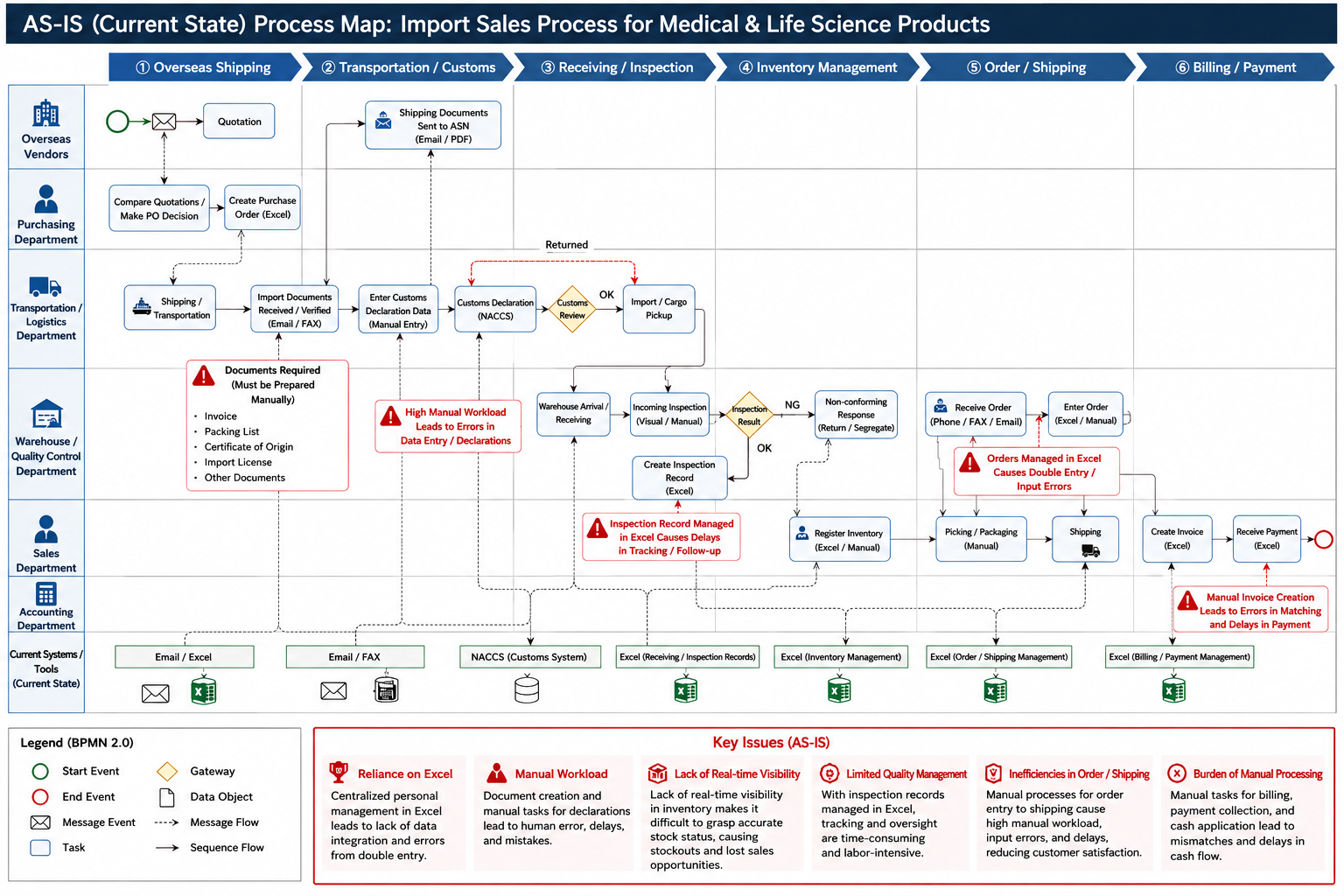
②Current Challenges (AS-IS): The Limits of Legacy Processes
| Current Challenge (AS-IS) | Business Impact / Risk |
|---|---|
| Fragmented system landscape Managed individually via standalone ERP or spreadsheets |
Information silos disrupt fast decision-making. Maintaining data integrity requires significant ongoing cost. |
| Excessive manual data entry in customs operations Document creation and system entry are largely manual |
Higher risk of human error in declarations. Customs delays extend lead time and add extra cost. |
| Lack of real-time inventory visibility Stock levels at each site cannot be checked instantly |
Lost sales opportunities from stockouts, or worsened cash flow from excess inventory. |
| Manual quality inspection process Inspection records and status tracking depend on individuals |
Increased compliance risk. A latent risk that defective products slip through, damaging company trust. |
③The Next-Generation Standard (TO-BE): An Integrated Process on SAP S/4HANA
In the next-generation “TO-BE” process, a digital platform centered on SAP S/4HANA (Private Cloud edition) is built to optimize the entire supply chain for medical and life science products.
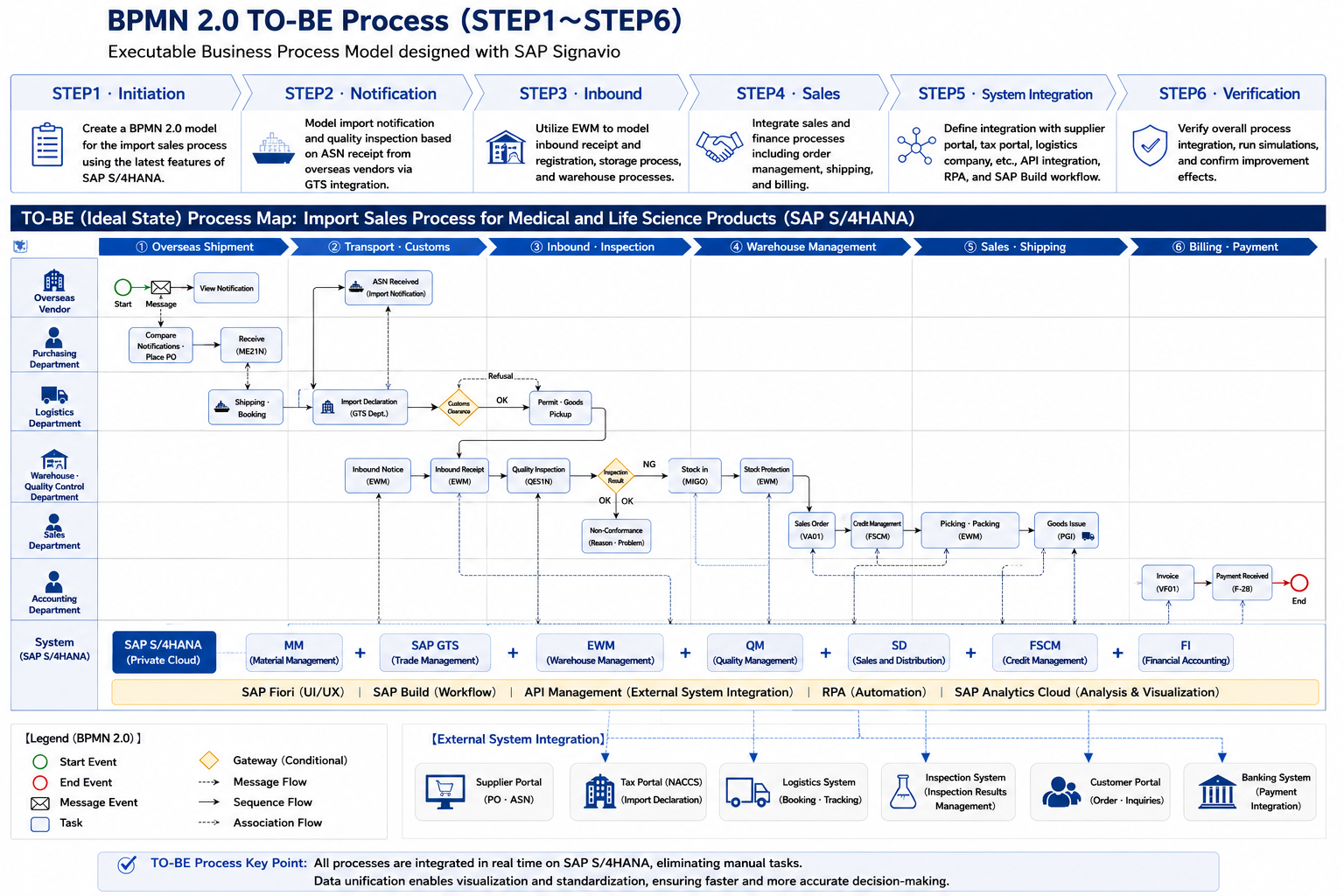
Import & Sales Process Map for Medical & Life Science Products (simplified)
Rows = departments / numbers = process orderSupplier
Broker
Assurance
Fail → Returned
(EWM)
Dept.
Core Module Integration
MM (Procurement & Inventory) & GTS (Global Trade Services)
Seamlessly integrates everything from purchase orders with overseas vendors to real-time customs processing.
EWM (Extended Warehouse Management)
Advanced warehouse control enables strict inventory management and storage tailored to product characteristics.
SD (Sales) & FI (Financial Accounting)
Manages everything end-to-end from order to billing to payment clearing, increasing cash-flow transparency.
Advanced Technology Foundation
SAP Fiori
Provides an intuitive UI that reduces operational errors in the field.
API Management & RPA
Drives automated integration with external systems and automation of routine work.
SAP Build
Rapidly implements business logic such as approval workflows.
SAP Analytics Cloud
Analyzes and visualizes collected data, powerfully supporting real-time management decisions.
④The Transformation Process: Visualizing & Building with BPMN 2.0
Using SAP Signavio Process Manager, the project “Medical & Life Science Product Import/Sales Process (SAP S/4HANA)” is modeled and built in the following 6 stages.
| Process Name | Key Actions | |
|---|---|---|
| 1 | Setup | Create a new “Executable” BPMN 2.0 model of the import/sales process, built on SAP S/4HANA’s latest capabilities. |
| 2 | Customs | Model the process from purchase order to overseas vendors (ME21N), ASN receipt, customs clearance (GTS integration), through to quality inspection (QE51N). |
| 3 | Inventory | Add goods-receipt notification, goods receipt, and stock posting/storage processes using SAP S/4HANA EWM and MIGO. |
| 4 | Sales | Integrate sales order (VA01), credit management via FSCM, shipping instruction (EWM), picking, goods issue, billing (VF01), and payment clearing (F-28). |
| 5 | System Integration | Reflect API integration and RPA with the supplier portal, customs (NACCS), logistics provider systems, and customer portal, plus workflow setup via SAP Build. |
| 6 | Validation | Verify the consistency of the overall process and confirm operational improvement effects through simulation. |
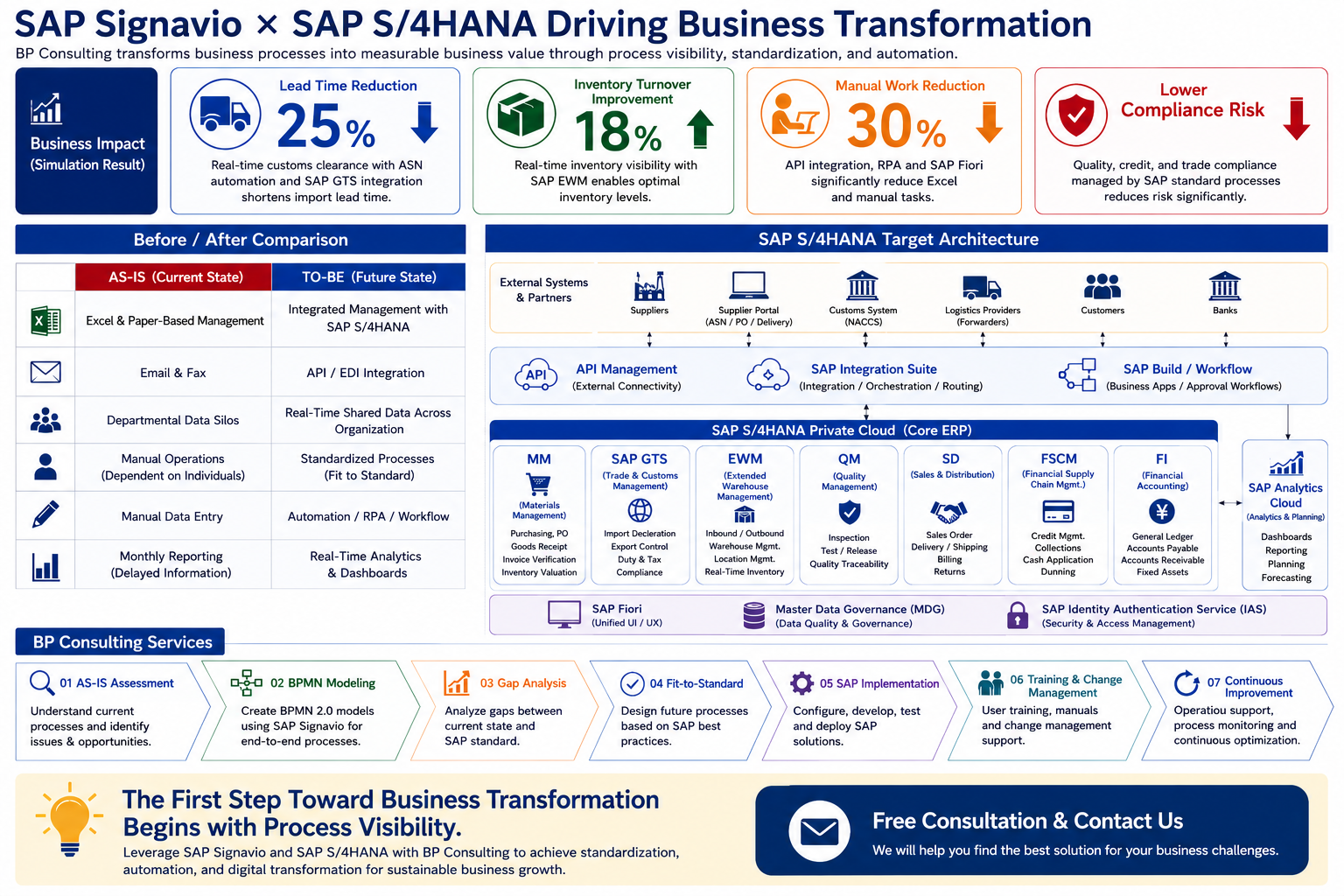
⑤The Impact in Numbers (Simulation Results)
Adopting the “TO-BE” process is expected to deliver the following dramatic performance improvements.
⑥Summary: The Operational Transformation Enabled by SAP Signavio × SAP S/4HANA
BPM consulting isn’t just about “visualizing operations.” Its ultimate goal is to translate operational improvement into measurable, quantitative results. The figure below brings together the impact, a Before/After comparison, the system architecture, and the scope of consulting services in a single view.
⑦Conclusion: Sustainable Growth Powered by Transparency
Process modeling with BPMN 2.0 using tools like SAP Signavio is far more than a diagram. It means securing operational “transparency,” sharing standardized best practices across the organization, and building an “executable model” that can be reflected into systems immediately.