

English For JP Univ. Entrance Exams
Learning System
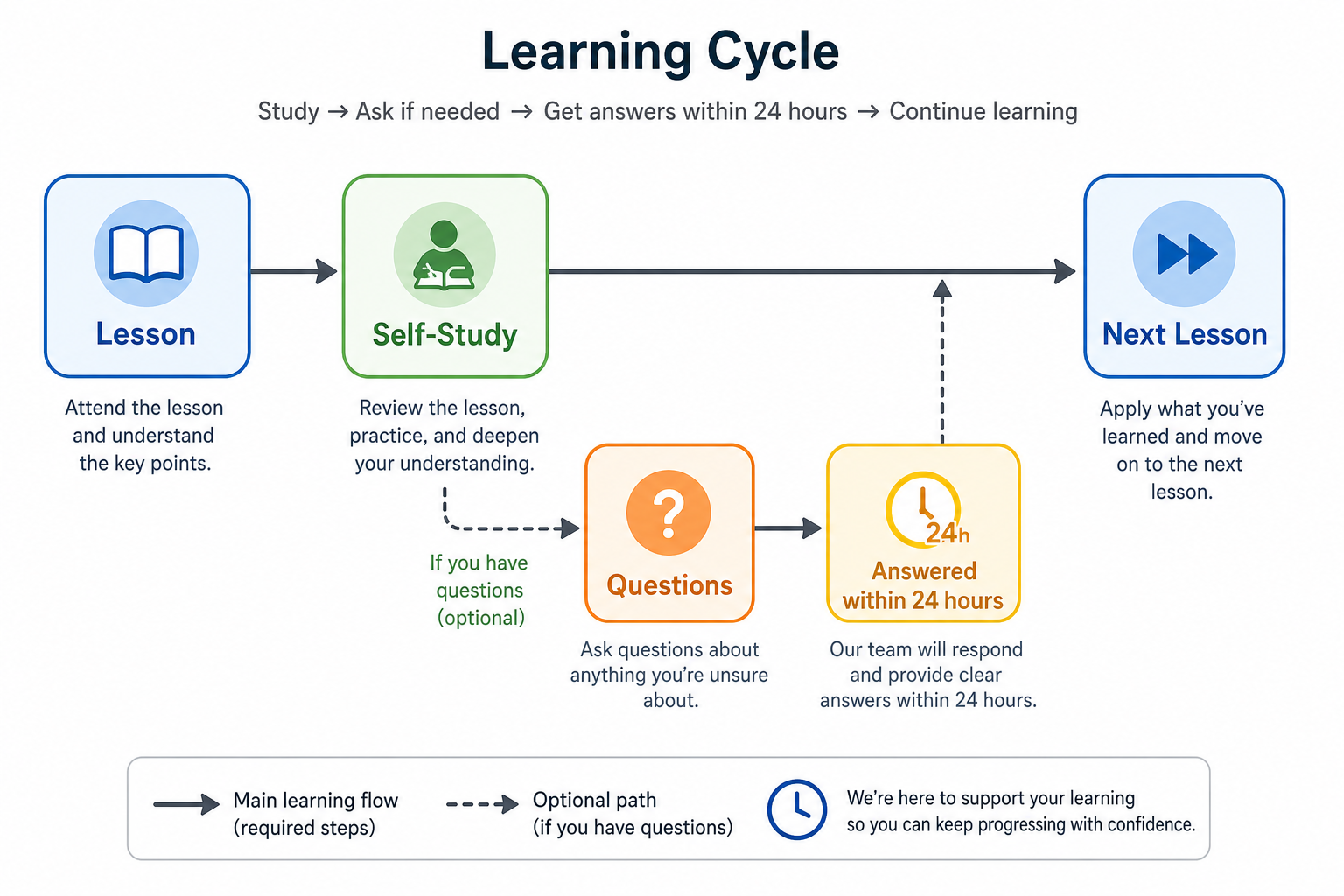
Original Learning Cycle
Learning progresses through a cycle of “Class → Self-study (→ Questions → Responses within 24 hours) → Next Class.” using commercially available and original teaching materials. Within this flow, I closely monitor each student’s understanding and pace, flexibly adjusting annual, monthly, and daily study plans.
“365 days a year, 24 hours a day” support
Even on non-class days, I guarantee responses to questions within 24 hours, 365 days a year. I ensure students never leave learning hurdles unaddressed, creating an environment where they can always move forward with confidence.
Small-group membership system
Through the personalized support only possible with the small-group membership system, I deliver peace of mind and tangible growth to both students and their families.
Learning Steps
- Grammar
- Knowledge Level→Concious Level→Unconcious Level
- Listening・Reading
- Close Listening→Extensive Listeing
- Close Reading→Extensive Reading→Speed Reading
- Speaking・Writing
- Instant English Composition Training・Free English Composition(150 words)
Learning Contents
Common Test for Univ. Admissions
Past Univ. Entrance Exams in Japan
Past Eiken Exams(2nd・Pre-1st)
In particular, I help you prepare for “The Common Test for University Admissions”, “General entrance exams”, and “External entrance exam use” to pass MARCH, Sei-Sei-Meigaku and Ni-Tou-Koma-Sen. Please feel free to contact me.
<Pass Record of My Students>
National University (Hitotsubashi /Chiba /Tokyo University of Marine Science and Technology)
Waseda-Keio (Waseda)
MARCH (Meiji/Aoyama Gakuin/Rikkyo/Chuo/Hosei)
Sei-Sei-Meigaku-Doku-Koku-Bu (Seikei/Seijo/MeijiGakuin/Dokkyo/Kokugakuin/Musashi)
Ni-To-Koma-Sen (Nihon/Toyo/Komazawa/Senshu)
Message to students
English Business Writing
The English you use in business writing tends to be formal and mundane. Not only does it sometimes fail to convey information and intent accurately, it can also interrupt the natural flow of communication. I am here to tell you how to write to achieve real business communication with human warmth. I proceed based on the following traditional basic rules of business writing.
- Be clear and concise
- Caring for others
- Use natural English
I use the following categories and proceed in the form of assignment corrections. In particular, I will show you how to write in a situation where you are angry when the other person is at fault, or if you are at fault, how to acknowledge that fact but ask the other person to understand. Here are just samples.
Correction Examples 🔺 Fault in the other party (e.g., inadequate answers to questions)
✖️ You didn’t answer my question clearly.
✔️ We appreciate your response; however, We would be grateful if you could clarify point #3, as it remains a bit unclear.
Key point: Cushion expression using “however” + “a bit unclear” to avoid horniness. This expression is a calm prompting to suppress strong emotions.
Correction Examples 🔻 Fault on your part (e.g., I gave insufficient information)
✖️ We are sorry I didn’t explain well.
✔️ We apologize for the lack of clarity in my previous message. We hope the following explanation addresses your concern.
Key point: The polite phrase “apologize for the lack of clarity” is used to acknowledge the fault but provide a positive supplemental explanation.
Correction Examples 🔺 Fault of the other party (e.g., misdirected order)
✖️ You sent the wrong order again.
✔️ Unfortunately, once again, it appears the items we received do not match our original order. Could you kindly look into this matter at your earliest convenience?
Key point: “Unfortunately, it appears…” is used to make a calm point. Even if the other party is at fault, add a polite word such as “kindly.
Correction Examples 🔻 Fault on your part (e.g., mistake on order form)
✖️ Sorry for the mistake.
✔️ We sincerely apologize for the error in our order form. We have corrected it and appreciate your patience and understanding.
Key point: “appreciate your patience” is a good business way to express your desire for the other party’s understanding.
Correction Examples 🔺Fault of the other party (e.g., being forced to resend materials repeatedly)
✖️ You asked for the file again and again.
✔️ Just to clarify, We have attached the file once more in case the previous email didn’t reach you. Please let us know if there are any issues accessing it. Key point: “Just to clarify” + “in case…” This is a gentle preamble that mentions the other party’s fault but does not blame the other party.
Correction Examples 🔻Fault on your part (e.g., failure to remind)
✖️ We forgot to inform you.
✔️ Please accept our sincere apologies for not sharing the update earlier. Thank you for your understanding and we will make sure to keep you informed going forward.
Key point: The phrase “not sharing the update earlier” acknowledges negligence and promises to take action in the future.
Correction Examples 🔺 Fault of the other party (e.g., late notification of change)
✖️ You should have told us earlier.
✔️ We would have appreciated receiving this update earlier, as it impacts our internal scheduling. We would be grateful if you could keep us informed promptly going forward.
Key point: “would have appreciated” in the subjunctive past perfect + “going forward” calmly conveys a request for the future.
Correction Examples 🔻 Fault on your part (e.g., misrepresentation of event dates)
✖️ We are sorry for the confusion.
✔️ Please accept our apologies for the confusion regarding the schedule. We have corrected the date and attached the revised notice below.
Key point: “Please accept our apologies” politely apologizes and “corrected the date” indicates a response.
Correction Examples 🔺 Fault of the other party (e.g., repeated delays in delivery)
✖️ This is the third time your delivery was delayed.
✔️ We have noticed repeated delays in delivery, which have impacted our operations. We would appreciate it if you could review your internal process and advise how this can be prevented.
Key points: Combination of “noticed”, “impacted”, and “appreciate it if…” to convey your dissatisfaction in a calm but clear manner.
Correction Examples 🔻 Fault on your part (e.g., delivery error)
✖️ We are sorry, it won’t happen again.
✔️ We deeply regret the mistake and are taking steps to prevent a recurrence. We truly value your continued support.
Key point: “taking steps to prevent a recurrence” gives specifics about preventing a recurrence, and “value your support” is a way to maintain the relationship.
Correction Examples 🔺 Fault of the other party (e.g., late payment)
✖️ You haven’t paid yet.
✔️ Our records indicate that the payment due on April 30 is still outstanding. We would appreciate it if you could confirm the status at your earliest convenience.
Key point: “indicate that…” + “still outstanding” in a passive, factual, presentational manner to calmly urge.
Correction Examples 🔻 Fault on your part (e.g., late payment on your part)
✖️ We are sorry we forgot to pay.
✔️ We sincerely apologize for the delay in payment. Due to internal processing issues, the remittance was delayed, but the transfer has now been completed.
Key point: “due to internal processing issues” carefully explains the situation, and “has now been completed” clearly indicates that the responsibility has been fulfilled.
If you would like a correction or a generated AI prompt, please feel free to contact me.
Business Negotiation English
The same logic is applied in modern global business when it comes to the basic steps of negotiation —such as making an offer, probing for terms, compromising, and closing a deal— as well as strategies for breaking through deadlocks.
By learning not only everyday conversation but also specific negotiation processes —such as making proposals, responding to the other party’s demands (reframing), seeking compromises, and reaching agreements— you will acquire the fundamentals of practical negotiation skills.