
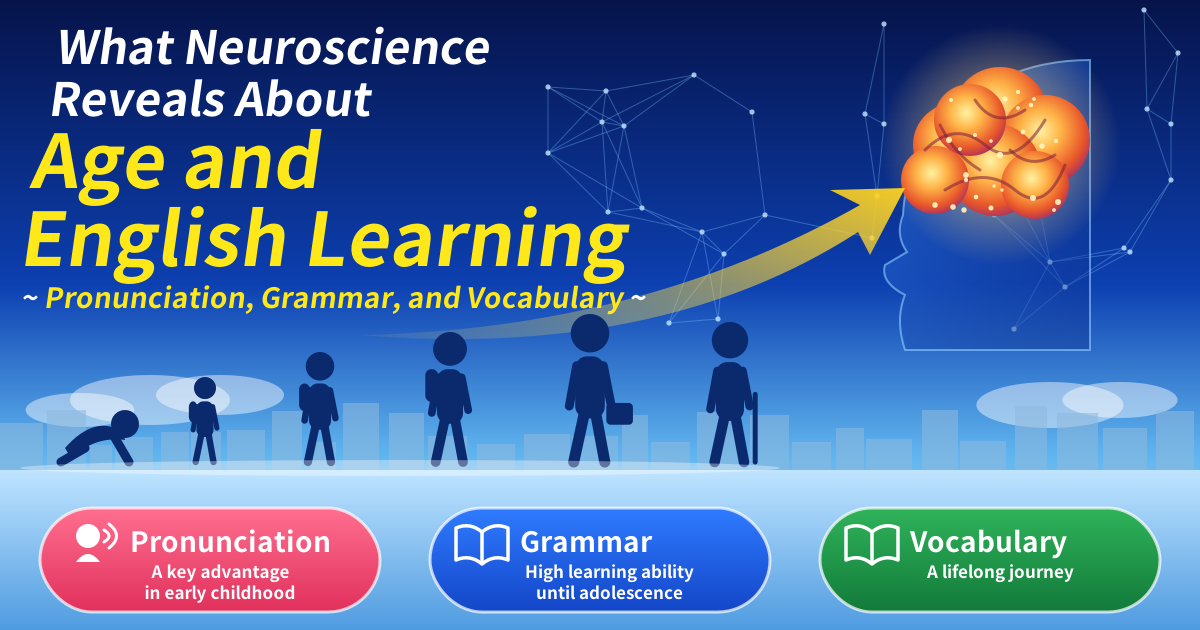
You may have heard claims such as “You have to learn native-like pronunciation in early childhood,” “Grammar must be mastered by middle school,” or “You can keep learning vocabulary throughout your life.” But what do neuroscience and second-language acquisition research actually tell us about the best ages for learning different aspects of English?
The key point is that language ability is not a single skill. Age affects pronunciation, speech-sound perception, grammar, vocabulary, and conversational fluency in different ways. Early childhood offers advantages for some aspects of language learning, but that does not mean learning becomes impossible after a particular age.
- Early language experience has a strong influence on how we perceive and produce speech sounds.
- Large-scale research suggests that the capacity for learning grammar remains high into adolescence. It does not mean that age 17 is a strict deadline.
- Vocabulary and expressive knowledge can continue to grow in adulthood. However, findings about general vocabulary knowledge should not be confused with research on learning words in a second language.
- You can improve your English while living in Japan by creating regular opportunities to listen, read, speak, write, and receive useful feedback.
- 1. Why Can Age Affect the Way We Learn English?
- 2. English Learning at Different Ages
- 3. Pronunciation, Grammar, and Vocabulary: How They Differ
- 4. How to Improve Your English While Living in Japan
- 5. What Does “Native-Level English” Mean?
- 6. Conclusion: You Can Make Progress at Any Age by Adapting Your Approach
- References and Further Reading
1. Why Can Age Affect the Way We Learn English?
The brain has the ability to change its neural connections and patterns of information processing in response to experience. This ability is known as neuroplasticity. A young brain is especially adaptable to the language environment, and early experience can have a lasting influence on how speech sounds are perceived.
For example, infants are initially sensitive to a wide range of speech-sound distinctions found across the world’s languages. During the first year of life, perception gradually becomes tuned to the sounds used in the languages they hear regularly. Children growing up in a Japanese-speaking environment may become less sensitive to certain English sound contrasts, such as /r/ and /l/, which do not distinguish words in Japanese in the same way they do in English.
Grammar and vocabulary learning involve several abilities, including memory, attention, abstract reasoning, and reading experience. Young children are skilled at picking up patterns through natural exposure, while older learners can make use of their ability to analyze grammar, compare examples, and plan their studies.
2. English Learning at Different Ages
0–1 year: The foundations of speech-sound perception develop
Infants can initially respond to many speech-sound differences, including contrasts that are not used in their home language. During the first year, their perception gradually adapts to the sound patterns they hear most often. For children growing up with Japanese, this can include reduced sensitivity to some English contrasts, such as /r/ and /l/.
Research in this area shows that the developing brain is influenced by its language environment from a very early age. However, simply playing English recordings to a baby does not guarantee future native-like pronunciation. The quality of language exposure, social interaction, and the broader learning environment all matter.
1–6 years: A favorable period for learning pronunciation and rhythm
During early childhood, children learn to imitate sounds and develop the rhythm and intonation of the languages around them. Regular exposure to English can help them become familiar with English vowels and consonants, syllable patterns, and the rhythm created by stressed and unstressed parts of speech.
That said, there is no strict rule that pronunciation must be completed by age six. People who had little exposure to English as young children can still learn to hear sound differences and improve their pronunciation later in life. As learners grow older, habits from their first language may have a stronger influence, so deliberate listening and speaking practice become especially useful.
6–12 years: Pronunciation, basic grammar, and vocabulary can develop together
During the school years, children continue developing pronunciation and rhythm while also learning vocabulary through reading and building a clearer understanding of grammar. This is a useful period for connecting basic word order, verb tenses, plurals, and questions with conversation and reading.
Combining listening and imitation with reading and writing can help learners connect sounds, written forms, and meaning.
12–18 years: An important period for advanced grammar and reading
During adolescence, abstract reasoning and the ability to analyze sentence structure continue to develop. Learners can study more complex grammar, including relative clauses, perfect tenses, conditional sentences, and relationships between parts of a sentence.
A large-scale 2018 study by Hartshorne, Tenenbaum, and Pinker analyzed data from 669,498 people. Its statistical model estimated that the ability to learn grammar remained at a high level until approximately age 17.4, after which it gradually declined.
18–30 years: Combine deliberate study with real-world practice
Adult learners can use their ability to compare grammar patterns, analyze mistakes, and make study plans. For example, they can first study the difference between the present perfect and the simple past, then use both forms repeatedly in conversation and writing to turn explicit knowledge into practical skill.
Pronunciation can also improve in adulthood. A 2025 meta-analysis of second-language phonetic training combined findings from 65 studies involving 2,793 learners and reported an overall positive effect of training on second-language phonetic competence. However, improved speech perception and achieving pronunciation that is indistinguishable from a native speaker’s are not the same outcome.
30–65 years: Expand vocabulary, specialist knowledge, and expressive range
Adults can build English vocabulary through work, hobbies, and areas of personal interest. Beyond learning definitions, it is useful to learn which words naturally occur together (collocations), which expressions fit particular situations, and how levels of politeness and nuance differ.
A review of age-related changes in vocabulary knowledge reports that scores on general vocabulary measures tend to increase through adulthood, reaching a peak at around age 65, and then remain stable or decline slightly. This finding mainly concerns general vocabulary knowledge. It does not show that every learner can acquire second-language vocabulary at the same rate until age 65.
65 and beyond: Continue learning and maintaining language skills
Some aspects of memory and processing speed can change with age. At the same time, vocabulary and accumulated knowledge can be relatively resilient. Reading material related to personal interests, continuing conversations, and trying out new expressions are practical ways to keep learning at a comfortable pace.
3. Pronunciation, Grammar, and Vocabulary: How They Differ
| Skill | How age can matter | Learning in adulthood |
|---|---|---|
| Pronunciation and speech-sound perception | Early language experience has a substantial influence, and first-language sound patterns become established. | Perception and pronunciation can improve. Combine sound discrimination, speaking practice, and feedback. |
| Grammar | Natural learning progresses through childhood and adolescence. The effects of age are not identical for every learner or grammar feature. | Understanding rules is possible. Using them accurately and quickly in conversation requires repetition and practice. |
| Vocabulary and expression | Knowledge and experience support continued growth in adulthood. | New words and specialist expressions can be learned. Study words in context rather than in isolation. |
Note: This table summarizes broad research trends; it does not assign numerical ability scores to specific ages. Outcomes vary with individual differences, study time, teaching methods, and opportunities to use the language.
4. How to Improve Your English While Living in Japan
Living in Japan does not, by itself, place a fixed limit on how far you can develop your English. However, when everyday life offers few chances to use English, you need to create those opportunities deliberately. The following four areas work well together in online English learning.
1) Pronunciation: Listen for differences, then practice aloud
- Compare short audio examples of English vowels and consonants that differ from Japanese sounds.
- Listen not only for individual sounds, but also for sentence stress, rhythm, and connected speech.
- Record your own voice and compare it with a model to identify areas for improvement.
- When possible, ask a teacher or another knowledgeable speaker for specific feedback.
2) Grammar: Use the rules you understand in real English
- After reading a grammar explanation, read example sentences aloud and connect their form with their meaning.
- Use the same grammar point to write short sentences about your own experiences or opinions.
- Keep a record of mistakes in conversation or writing, then try using the corrected form again later.
3) Vocabulary: Learn common word combinations, not just individual words
- Learn how a word is used with other words and prepositions, not just its dictionary meaning.
- Use example sentences and conversations to understand the situations in which an expression is natural.
- Instead of trying to memorize a large number of words at once, review them over spaced intervals and practice recalling them.
4) Conversation: Practice communicating your ideas
- During lessons, go beyond one-sentence answers by explaining your reasons and giving examples.
- Practice asking someone to repeat or clarify, rephrasing what you mean, and checking that you have understood correctly.
- Talk not only about everyday topics but also about subjects you care about and your own opinions.
5. What Does “Native-Level English” Mean?
The phrase “native-level” can refer to several different things: pronunciation that resembles that of a first-language speaker, accurate grammar, a broad vocabulary, or the ability to choose natural expressions for different situations.
It is important to distinguish having an accent from being easy to understand. A speaker may retain some influence from their first language and still speak clearly, communicate naturally, and take part in conversations with confidence. The goal of learning English does not have to be the perfect reproduction of one particular national or regional accent.
It is helpful to define your goals in practical terms, such as clear pronunciation, grammatical accuracy, a wide range of vocabulary, or flexibility in conversation. This makes it easier to choose what to practice.
6. Conclusion: You Can Make Progress at Any Age by Adapting Your Approach
| Age range | What to focus on |
|---|---|
| 0–6 years | Experiences with speech sounds, pronunciation, and rhythm |
| 6–12 years | Listening, basic grammar, foundational vocabulary, and reading |
| 12–18 years | Complex grammar, reading comprehension, writing, and conversation |
| 18–30 years | Using grammar in context, improving pronunciation, and practicing conversation |
| 30–65 years | Vocabulary, specialist knowledge, natural expressions, and practical experience |
| 65 and beyond | Interest-based learning, expanding knowledge, and continued language use |
Research does not support a simple rule that “pronunciation must be learned in early childhood, grammar by middle school, and vocabulary throughout life.” Early experience strongly influences speech-sound perception; research suggests that the ability to learn grammar remains high into adolescence; and vocabulary and expressive knowledge can continue to accumulate in adulthood.
It is never too late to start improving your English. What matters is choosing methods that suit your current needs and continuing to engage with the language, use it, and reflect on your progress.
References and Further Reading
This article draws on research into second-language acquisition, infant speech perception, vocabulary knowledge across adulthood, and second-language pronunciation training.
- Werker, J. F., & Tees, R. C. (1984). Cross-language speech perception: Evidence for perceptual reorganization during the first year of life. Infant Behavior and Development, 7(1), 49–63. View article details (DOI)
- Kuhl, P. K. (2010). Brain mechanisms in early language acquisition. Neuron, 67(5), 713–727. Read the article (PubMed Central)
- Hartshorne, J. K., Tenenbaum, J. B., & Pinker, S. (2018). A critical period for second language acquisition: Evidence from 2/3 million English speakers. Cognition, 177, 263–277. Read the article (PubMed Central)
- Saito, K. (2024). Age effects in spoken second language vocabulary attainment beyond the critical period. Studies in Second Language Acquisition, 46, 3–27. View article details (Cambridge University Press)
- Kavé, G. (2024). Vocabulary changes in adulthood: Main findings and methodological considerations. International Journal of Language & Communication Disorders, 59(1), 58–67. View article details (DOI)
- Yao, Y., He, M., Chen, F., & Zhu, J. (2025). A meta-analysis of second language phonetic training: Exploring overall effect and moderating factors. Journal of Speech, Language, and Hearing Research, 68(4), 1784–1802. View article details (PubMed)
The studies cited here differ in their participants, methods, and learning environments. Their findings do not guarantee the same outcomes for every learner. The age ranges in this article are intended as general guides, not precise boundaries at which an ability switches on or off.